 Jason Reed, Certified Health Coach & Wellness Writer
If you have spent any time standing in the supplements aisle wondering which bottle will actually do something for your concentration, you are not alone. The global nootropics market is worth billions, yet most products are backed by more marketing than science. This guide cuts through the noise and focuses on the supplements with the strongest evidence behind them, particularly those aligned with a plant-based and natural health approach.
Which Supplements Actually Improve Concentration?
The honest answer is that a handful of compounds have genuine, replicated research showing measurable improvements in focus, memory, and mental clarity. The key is knowing which ones those are and what doses actually matter.
Does Lion’s Mane Mushroom Really Sharpen Focus?
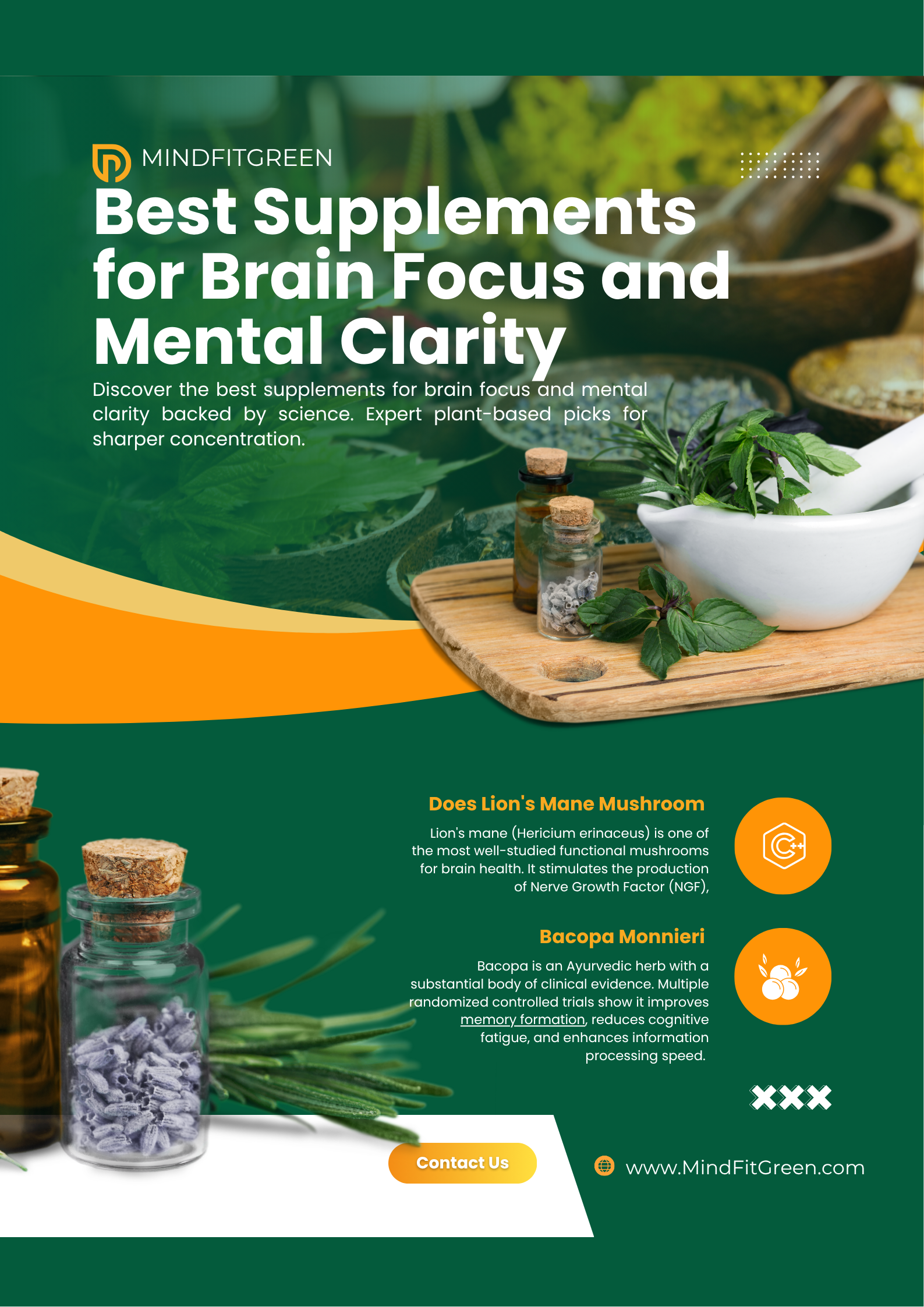
Lion’s mane (Hericium erinaceus) is one of the most well-studied functional mushrooms for brain health. It stimulates the production of Nerve Growth Factor (NGF), a protein essential for maintaining and growing neurons. Two human studies published in the journal Phytotherapy Research found that older adults who took lion’s mane daily for 16 weeks showed significant improvements in cognitive function compared to placebo. For focus and mental clarity specifically, lion’s mane appears to support the long-term architecture of brain health rather than providing an immediate stimulant effect. Aim for 500 to 3,000 mg of a standardized extract daily.
Is Bacopa Monnieri Worth Taking for Memory and Concentration?
Bacopa is an Ayurvedic herb with a substantial body of clinical evidence. Multiple randomized controlled trials show it improves memory formation, reduces cognitive fatigue, and enhances information processing speed. The catch is that bacopa is slow-acting. Most studies show meaningful results after 8 to 12 weeks of consistent use. If you are looking for a fast fix, bacopa is not it. If you are building a sustainable cognitive enhancement protocol, it belongs in your stack. The effective dose range is 300 to 600 mg daily of a standardized extract containing 50 percent bacosides.
What Does Omega-3 DHA Do for Brain Focus?
DHA (docosahexaenoic acid) is a structural fat that makes up roughly 60 percent of your brain’s fatty acid content. When DHA levels are low, neuronal membranes become less fluid, which impairs the speed and efficiency of brain signaling. Research from the National Institutes of Health consistently links adequate DHA intake with better attention, memory, and processing speed. For plant-based individuals, algae-based omega-3 supplements are the gold standard since they provide both EPA and DHA without fish, and algae is in fact where fish get their DHA from. A dose of 400 to 600 mg DHA daily is well supported by the research.
What Are the Top Vitamins for Cognitive Support?
| Supplement | Primary Benefit | Effective Dose | Onset |
| Lion’s Mane Mushroom | NGF production, long-term focus | 500-3,000 mg/day | 4-8 weeks |
| Bacopa Monnieri | Memory, information processing | 300-600 mg/day | 8-12 weeks |
| Algae Omega-3 DHA | Neuronal membrane health | 400-600 mg DHA/day | 4-8 weeks |
| Rhodiola Rosea | Mental fatigue, stress resilience | 300-600 mg/day | 1-4 weeks |
| B-Complex (B6, B9, B12) | Neurotransmitter synthesis | Per RDA or above | 2-4 weeks |
| Magnesium L-Threonate | Synaptic density, memory | 1,500-2,000 mg/day | 4-6 weeks |
Are B Vitamins Essential for Brain Health?
B vitamins, particularly B6, B9 (folate), and B12, are directly involved in producing neurotransmitters like serotonin, dopamine, and acetylcholine. They also regulate homocysteine, an amino acid that at elevated levels is linked to cognitive decline and brain atrophy. Deficiency in B12 is especially common among plant-based eaters and is a frequently overlooked cause of brain fog and poor concentration. Supplementing with a high-quality B-complex or methylated B12 (methylcobalamin) is non-negotiable for most people following a vegan or vegetarian diet.
Read More: What Are the Best Natural Remedies for Anxiety and Stress Relief?
How Does Rhodiola Rosea Help With Mental Fatigue?
Rhodiola is classified as an adaptogen, meaning it helps the body and mind resist both physical and mental stress. Clinical trials show it reduces mental fatigue and improves performance on cognitive tasks under stress conditions. Unlike stimulants, it does not cause a crash. Rhodiola works by modulating the stress hormone cortisol and supporting mitochondrial energy production in brain cells. The effective dose is 300 to 600 mg per day, standardized to 3 percent rosavins and 1 percent salidroside. This makes it one of the more versatile natural focus supplements available.
Can Magnesium Improve Brain Function and Focus?
Most adults are deficient in magnesium, and the brain pays a steep price for it. Magnesium is involved in over 300 biochemical reactions, including those governing neurotransmitter activity and synaptic plasticity, which is the brain’s ability to form and strengthen connections. Magnesium L-threonate is the specific form that crosses the blood-brain barrier most effectively. Animal studies and early human trials suggest it increases synaptic density in the prefrontal cortex, the region most associated with focus and executive function. This is an area where more human research is still needed, but the early data is promising enough to justify inclusion in a cognitive support protocol.
Are There Any Natural Supplements That Work as Well as Prescription Focus Drugs?
This is one of the most common questions in the nootropics space, and the answer requires nuance. Natural supplements like bacopa, lion’s mane, and adaptogens do not produce the acute, dramatic focus effect of prescription stimulants. What they do is support the underlying biology of a healthy, well-functioning brain over time. For many people with lifestyle-driven brain fog, the results of a well-designed supplement protocol combined with good sleep, exercise, and nutrition are genuinely transformative, without side effects or dependency risk. The plant-based approach is a long game, and it is one worth playing.
Ready to go deeper? At MindFitGreen.com, we break down the science behind plant-based health, natural remedies, and mental wellness so you can make confident, informed choices. Explore our full library of evidence-backed guides to support your brain, body, and overall wellbeing. Your healthiest life is one well-researched article away.
